Sunday, May 27, 2007

Eww, petunias


Eww, petunias


I have never liked petunias. They're exactly what I think flowers shouldn't be... worthless in bouquets, disgusting to the touch, and even more disgusting to smell. But after seeing baskets of wave petunias priced at twenty to thirty dollars in nurseries and at the supermarket, I figured I'd give a sale packet of 'cascading' petunia seeds a shot.

When I opened up the packet and found tiny, pelleted seeds inside, I grew even more skeptical. With such small seeds, I doubted the germination rate would be very high, and pelletized seed is often even less likely to sprout properly. But I went ahead and planted them in a nine-cell seed-starting tray, measuring out three seeds per cell in order to calculate germination ratios.

Boy, was I in for a surprise. Germination was a respectable seventy percent, which left me with a lot of seedlings! Instead of thinning, I repotted the extra seedlings into their own containers, and miraculously failed to kill a single one. The plants in the photo are ready to be stuffed into baskets along with some pansies and Calibrachoa (million bells). I'm really happy with the variety of colors that popped up. That, and the "easy to grow" factor, almost makes me not completely hate petunias anymore.

(They still stink, though!)

Saturday, May 19, 2007

Bainbridge inspiration


Bloedel Reserve Visitor Center

My sister came to visit last week, which is why I haven't posted in a while-- we had a lot of fun running around Western Washington, eating good food and shopping up a storm. Of course, with both of us being cameraholics, we had to go on some kind of photo expedition... which took us to Bainbridge Island and the Bloedel Reserve.

The Reserve is different from botanical gardens that we've visited in the past in that it was largely designed to mimic nature rather than display plants or flowers. Much of the Reserve's woodland was covered in plants that I recognized from woodlands in my home area; at times, the only thing that revealed the hands of the landscape's careful maintainers was the conspicuous absence of fallen branches and other clutter. At the end of the day, I came away with a greater appreciation for native plants-- and an aspiration to compile a personal library as impressive as the one at the Reserve's visitor center.

Visiting the Reserve requires a reservation; it may seem like an extra hassle, but once you get there, it's easy to understand why the number of visitors is limited. The sights are best appreciated without the distraction of crowds.

For more photos, check out my Vox-based Bloedel Reserve photo collection. Sadly, I forgot my own camera, so if the photos seem better than usual, it's all on account of that. (Thanks for the loaner, Sis). Maybe it's time for an upgrade... seven megapixels and a foliage setting spoiled me!

---
Cross-posted to Vox.

Sunday, April 29, 2007

Upgrade time


Wintersown larkspur seedling


Remember all those wintersown containers that I started back in January and revisited in March? Well, I finally got around to transplanting them into larger containers this past week. They're so much happier now, and they're already starting to take advantage of the extra root space. I can't wait to plant them out in the garden.

The wintersown plants weren't the only ones to receive an upgrade. Some petunias that were outgrowing their plug trays have been moved to 4" pots, along with about 10 extra parsley seedlings (I have a feeling I'll be giving away parsley this year, along with the extra cabbage starts). My second batch of tomato seedlings were upgraded to quart-sized yogurt containers, and actualy looks as if they might catch up to their older siblings being hardened off outside.

I neglected to mention that the majority of my vegetable seedlings are out in the garden now, with only the truly tender summer plants (tomatoes, peppers, and squash) still being hardened off or sheltered indoors. For some reason, it just hasn't sunk in that tomorrow is our "safe date" for planting-- even those crops will have to be planted out this week.

Where does the time go?

Saturday, April 28, 2007

Dahlias, dahlias, dahlias


Dahlia cutting


If you've been following this blog, you know that I have a Dahlia Problem. The problem is, I keep buying dahlias every spring, and have nowhere to put them. :-/

Well. I bought more dahlias this year, and suffice it to say that January's rotted tuber disaster may have turned out to be a blessing in disguise, since I went even more overboard than usual. This year, aside from my normal sources (the local dahlia society and packaged supermarket tubers), I tried something new and ordered dahlias online from a specialty grower in California. I was really excited about this-- in fact, I put in my order on the first day that the catalog opened last fall to ensure I'd get the varieties I wanted. And aside from one acceptable substitution, I was not disappointed.

The photo at top shows one of the dahlia plants that I received from that grower last week. These plants were grown from cuttings, rather than tuber divisions; I love this photo because you can see a baby tuber already forming in the tiny little plug pot. I could hardly believe how efficiently the plants were packaged-- these plugs were tucked into plastic containers not unlike the kind used to package fresh herbs at the supermarket, and everything arrived in excellent condition. If all goes well, I'll happily recommend the grower.

I won't list every variety I ordered, but have to mention that one of my purchases from that source was Ruskin Marigold (magnificently photographed by Eric of SF on Flickr), which I've been after since seeing it displayed at the South Bay Dahlia Society show in Southern California a couple of years ago. My order also came with two bonus plants... never let it be said that crack pushers nursery vendors aren't kind folk.

Now I just have to find the time to get my new babies into the ground! I've been so busy potting up and transplanting my wintersown flowers that I haven't had time to breathe... but that's a subject for another post!

Friday, April 13, 2007

African violet update


African violet propagation in water


It took a bit longer than I expected, but the African violet leaves that I talked about in January have finally sprouted baby plants! This goes for both the leaves planted in vermiculite as well as the leaves left in water.

You can see what the vermiculite cups look like now at Flickr. Those leaves just broke the surface of the vermiculite last week. They look much sturdier than the leaves growing in water.

I'm going to try transplanting the water-propagated plants to well-moistened vermiculite when they get a little larger to help them develop soil roots.

---
Cross-posted to Vox.

Monday, April 02, 2007

Pineapple sage


Pineapple sage blossom


Before I started growing vegetables, I had a big crush on herbs. Vegetables took too much maintenance and space, and as for ornamentals, I told myself that I wasn't interested in any plant that couldn't earn its keep. But there was one herb included in all of my balcony and patio gardens that I could never fully justify-- pineapple sage.

Pineapple sage is not a particularly useful herb. Unlike culinary sage, it isn't very aromatic: the leaves smell pleasant, and faintly sweet, but not really like pineapple. It is not as hardy as culinary sage; it's considered a tender perennial, which means it wilts at the first touch of frost. It has no known medicinal value. The best suggestion any herb book can come up with for using it is to steep the leaves with other herbs for a tisane, or to use springs and blossoms as a garnish for cold drinks.

It hasn't turned out to be low-maintenance, either. Every one of my plants has attracted aphids-- the ones stressed by too much heat and sunlight are a more potent aphid magnet than roses. They do well outside in partial sunlight in Washington, but frost inevitably hits before they bloom-- that's just been my luck with them for the past seven or eight years.

So imagine my surprise when my root-bound, insect-ridden overwintered cuttings started sprouting racemes last week. O.o

The flowers are as beautiful as the nursery tags promise-- a gorgeous shade of vivid scarlet. If only I could get these plants to do this outdoors! Maybe I've been treating my plants too kindly-- rosemary, for instance, only blooms under stress. Maybe they need to be root-bound, overheated, and dehydrated. I suppose it's worth a try.

For now, though, I'm just going to kick back and enjoy this little run of luck. We're still getting snow in spurts outdoors, so this may be the biggest show I see for a while.

And I gotta tell ya-- after seven years of nothing, it feels like a mighty fine show.

---
Cross-posted to Vox.

Friday, March 30, 2007

A quick shout-out to my peeps in L.A.

I can't resist passing this link on:

Digital Gardener's Southern California Vegetable Planting Schedule

Sometimes as I'm staring out at our Western Washington winter rains, I wonder what I'd be planting and harvesting if I still lived in Southern California. Well, now I know. It amazes me that the months I spend inside, pining for greenery that ain't a poinsettia, are the optimal months for planting over half the crops on the list.

It looks like it's time for Southern California gardeners to plant summer crops-- tomatoes, squash, corn, beans. I'll be starting some of those crops indoors here, as well, in order to get a head start on our shorter growing season.

I'm jealous of all the Mediterranean and other heat-loving delights I remember from childhood: avocados fresh from the tree, figs, citrus, loquats, and peaches. I even miss the damn bougainvillea that left me nicked up for a week from pruning it. But then again, I remember the days of mournful yearning for a lilac that would tolerate and bloom in zone 9, and the cherry trees in my Washington backyard would probably wither and pout through an L.A. summer, so I guess all things even out in the end.

Tuesday, March 27, 2007

Getting to it


Dividing rhubarb

I once read that one of Rosemary Verey's favorite phrases was "Get to it." Being a master procrastinator, I'm generally pretty bad about getting things done, but since we just got our first break from the rain in two or three weeks, I finally got started on a long-overdue task: dividing the rhubarb.

The rhubarb came with the house-- planted, presumably, by the previous occupants. There are two large clumps of it, and while they shoot up vigorously in the spring, they've never really produced very well. The stalks are mostly spindly, and we never seem to get more than four or five of them per crown. I've been meaning to divide the clumps since the first summer we lived here, but every year, it gets put off, undoubtedly because early spring up in our parts is almost always rainy and cold.

Today, I tackled the first of the two clumps, dividing it into four smaller clumps. I'm not sure what I was expecting, but the heart of the plant turned out to be a giant, solid mass of root. I'd meddled around the base of the plant before, and had come across more conventional-looking roots... thick, fleshy, but definitely recognizable as roots. As it turns out, beneath the center of the plant, it's one big congealed knot, and in the case of this plant, that knot was nearly a foot-and-a-half around. That was not what I was expecting at all, so I cleaved it down the center with a shovel. I hope it all works out.

Other things I've gotten down to this past week:

  • I pruned the grapes, lavender, and lavatera, and have started working on the roses. I'm a little behind schedule on all of this, but since I'm always late, every year, and the plants have never seemed to mind, I think it'll be okay. Husband helped with the grapes, and as usual worried that I was pruning too hard. He says the same thing about the lavatera, his favorite flowering plant, which he's convinced I'm trying to kill. The lavatera, by the way, is a cultivar known as "Barnsley," which was first cultivated by... guess who? Rosemary Verey, at her famous Barnsley House garden.

  • I have started potting up some of my dahlia rubers to give them an early start on the season. I'm happy to report that no further tubers have rotted since January's tragedy, although a couple seem to have dried out, including some of my divisions of 'Pam Howden.' Luckily, this year's local dahlia society tuber sale falls on a Sunday, rather than a Saturday, so I should be able to recover the loss. I nearly danced around my cubicle at work when I discovered this fact, which may give you some idea of how obsessed I am with my dahlias. I still have no idea where I'm going to plant them all... have I mentioned that I also ordered about ten plants to be delivered in April? *headsmack*

  • My garden auricula is starting to bud, which prompted me to head to the nursery to see if they had any different colors in stock yet. Sadly, they didn't, but that didn't stop me from browsing. I came away with some purple Calibrachoa (million bells) for hanging baskets and... wait for it... more frakking dahlia tubers!

  • I transplanted my tomatoes to larger containers and started more tomatoes in seed cells, as well as basil and okra. This week, I'm planning to start some lettuce and transplant the cabbage and pac choi to larger pots. I've been watering my seedlings with diluted fish emulsion this year; it's not as odorless as the bottle claims, but if it gets me healthier seedlings, I can live with it. Although I suspect that the cats may be drinking from the drip trays.

  • Blogwatch: Gayla at You Grow Girl has written a couple of excellent posts on the subject of seed-starting. Mr. Brown Thumb has been recording the process of saving Amaryllis / Hippeastrum seeds. This intrigues me because although I can't get my existing Amaryllis to rebloom, I've been thinking of taking up Hippeastrum as a hobby, following in the footsteps of George Washington Carver, who was apparently an enthusiast.
I can't believe how late it is now. I hate to rush a post, but it's time for me to hit the sack. I'll bang my head over typos in the morning. For now, I leave you with my favorite find from the garden today:

Glory of the Snow and a volunteer pansy

Take care, all!

---
Cross-posted to Vox

Monday, March 26, 2007

Lawn Ornament Tragedy


Oh noes, it's Bambi's mom

Our neighbors claim that their deer lawn ornament has simply fallen and can't get up. Personally, I think it's some kind of Disney allegory about animal orphanhood. Or a warning to any stray deer that should happen to wander into town to nibble on that barberry bush.

Anyway, this little scene of lawn ornament tragedy has been on display in their front yard for almost half a year now. They seem like normal people, but apparently they have a morbid sense of humor.

---
Cross-posted to Vox.

Monday, March 19, 2007

Organic fertilizer


Now blooming: forsythia

I know that today's photo doesn't really match the topic of fertilizer, but after two weeks of posting pictures of nothing but dirt, more or less, I figured it was about time for a break.

Fertilizer may not be much to look at, but it does wonders for a garden. Up until now, I've relied on compost, manure, and Osmocote to keep my veggies going, but this year, I wanted to break my dependence on Osmocote and switch to something more organic. The cost always seemed prohibitive in the past, but luckily, last year I started working for a chain of farm-and-feed stores that sell lawn and garden products, and our year-end bonuses came in the form of a generous gift certificate. A sane, non-livestock owning woman would probably have gone after a nice new coat, or expensive tools, or even patio furniture with that kind of money to throw around.

Not me. I wanted fertilizer. The equivalent of over two hundred dollars' retail worth of it. *headsmack*

This would not be a funny story except that I vastly overestimated how much I would need for my plot, which figures at about 100 square feet of workable space. And anyway, it was essentially free!! fertilizer!! Maybe I just didn't read the application rates closely enough. Long story short, I bought cottonseed meal, bone meal, kelp meal, alfalfa meal, dolomite lime, garden lime, greensand, and gypsum, but in such outrageous quantities that the store employees raised eyebrows at me. As I hauled the fifth bag of seed meal into my car, it should have occurred to me that I had overdone it. Alas, no.

Oh well. I didn't need that patio furniture, anyway.

To sum it all up: I have enough ingredients to keep me in fertilizer for the next eight years. If you're interested, the recipe I used was Steve Solomon's "complete organic fertilizer" blend, which is available on the Mother Earth News website here (I added some greensand for additional minerals). Solomon's Gardening West of the Cascades was an excellent research tool; I also referred to Eliot Coleman's classic Four Season Harvest. My first batch was whipped up last month, and I'll be amending my beds just as soon as the rain lets up... which the weather report tells me ain't gonna be happening anytime soon.

In the meanwhile:

  • I've been working on entering my seed-starting data into a spreadseet over at EditGrid. So far, I'm happy with the site-- it's free, and the interface is pretty intuitive for anyone who's familiar with spreadsheet applications.
  • My wintersown larkspur seedlings have set their first true leaves! And the two flats of columbines that had one seedling each mid-week are definitely sprouting.
  • The crocuses have finished blooming, while the clumps of Dutch iris received from a co-worker and planted last fall have started sending up growth.
  • I spotted my first bumblebee of the season today, making eyes at the potted hellebores on the porch.
  • My ever-growing to-do list: 1) Dig up rhubarb. 2) Enlarge center bed. 3) Amend beds with fertilizer. 4) Replant rhubarb and strawberries; move herbs as necessary. 5) Prune grapes, lavatera, rhododendron.
---
Cross-posted to Vox.

Tuesday, March 13, 2007

Fresh from the deli aisle


Wintersown delphinium seedlings

A quick update on those wintersown containers that I blogged about in January: 4 out of 10 trays have sprouted so far! It looks like I'll have plenty of pansies, delphinium, and larkspur in the garden this year. As for the latecomers, I'm still hoping that the columbines, at least, will make a show. So far, there are only two seedlings in the four trays I planted. I love columbines, but haven't had much luck growing them so far. Thank goodness I spied this thread at GardenWeb-- at least I know I'm not alone!

I went out and cleared mulch from the vegetable beds today in preparation for making them slightly wider and longer (in theory, to accomodate all the new seed varieties I bought this year). I was hating Daylight Savings this morning-- I have enough trouble getting out of bed without having to get up a whole hour earlier-- but in the evening, when I realized that there was enough daylight left at 6:30 PM to hit the garden after work, boy, did my attitude change! I'm looking forward to getting the beds reshaped by the end of the week-- then I can get started on moving the rhubarb and working in fertilizer.

I still haven't told you my fertilizer story yet! I guess that'll be one for next week.

---
Cross-posted to Vox.

Saturday, March 10, 2007

Time to get my garden on


Seed-starting tray

We've got a storm headed our way, with eight inches of rain expected over the next three days, so apparently winter's not quite done with us yet. Warmer weather seems like a far-off dream, but I'm not going to let the chill outside dissuade me from commencing with spring gardening indoors. My seed-starting chart tells me that now is time to begin sowing vegetable seeds up here in my corner of the Pacific Northwest, and in answer, I have gone forth and filled my seed trays! (Yea verily!)

I have a nifty new seed-starting gadget this year, a Christmas present from my husband: it's a seed-heating mat, which holds a temperature 10 - 20 degrees above ambient and is used to improve germination rates. Back when we lived in Italy, we had a tiled ledge in our bathroom that was built in right over the wall heater; even trays of notoriously difficult lemongrass seeds sprouted easily in that spot. I'm counting on the mat to get my tomatoes and peppers going; later in the season, I'll use it to give my African violet cuttings a boost.

So far, I've got pak choi, cabbage, sorrel, beet, chard, and tomato seedlings popping up, with fennel, parsley, and jalapeno yet to break ground. Tomorrow, I'll be adding leeks and flower seedlings. I have a feeling I'll be needing more windowsill space... but I'll just have to deal with that problem when I come to it.

Outdoors, sweet peas are sprouting (yes, I finally got them planted) and the crocuses are in full glory. Up and down the street, ornamental cherry trees are coming into bloom, and our forsythia looks like it's ready to burst into flower. Once this storm is over... it might actually be spring.

I can't wait!

---
Cross-posted to Vox.

Wednesday, January 24, 2007

False spring


Hyacinth 'Splendid Cornelia'

It was a glorious 55 degrees today... what a lovely warm spell after two weeks of snow and ice! To add to the whole spring vibe, the first of my forced hyacinth bulbs has started to bloom at a time when the tulips and dutch iris outdoors are just starting to peek up out of the ground. The scent is wonderful. I have to remember to hunt down cheap hyacinth bulbs again in the coming fall.

Beside the tulips, rhubarb is starting to pop up outdoors, which reminds me that I've been planning to dig up the existing clumps and divide them this year. It's probably too early to get started with the digging, but it's never too early to start planning... and I've got a lot of planning to do this year, especially since I've got more seed varieties than my 100 square feet of garden can support. These divisions are going to need a lot more space, more sunlight, and plenty of fertilizer, and I'm short on everything but the fertilizer.*

Speaking of lack of space and more sunlight, this coming week, I need to get sweet peas (not to mention my beloved snow peas) planted. Last year, I unwisely planted my sweet peas in shade, and to make a long story short, they were spindly and pathetic. I overcompensated by buying three packages of sweet pea seeds for this year, and once again, I can't find a sunny place to plant them. So I'm setting myself a deadline to find a spot or make one-- next week, I'll either be blogging about my newly planted sweet peas, or sheepishly wallowing in shame and self-loathing.

So yeah, my sweet peas and I will be seeing you next week. (eep!)

---
* - but that's a story for another week.

Cross-posted to Vox.

Sunday, January 14, 2007

Meanwhile, indoors...


Propagating African violets

Temperatures this past week have been consistently below freezing. Outside, we've got snow lingering on the lawn and an icy stalagmite slowly forming on our back porch. inside, it's a different story:

1) Last weekend, I took some African violet leaf cuttings that I brought home from California and started trying to grow baby plants from them. I'm really excited about this project. The leaves are tucked into moist vermiculite in clear plastic cups sitting in my kitchen window, where I can keep an eye on them. I have to admit, the plastic cups are starting to grow on me-- they make such cute recycled mini-terrariums.

2) Back in November, a local store had packages of hyacinth bulbs on the clearance rack for under a dollar. I made up some improvisational forcing vases from empty Maille dijon jars, filled them with enough water to keep the base of the bulbs moist without touching, then wedged the bulbs in the openings and stored them in the refrigerator for six weeks. They're now out in my front window, and the leaves are starting to fan out nicely. I love the scent of hyacinths! I can't wait until they bloom.

3) Here's the not-so-pleasant one: back at the beginning of November, I packed my dahlia tubers away for the winter using a new method. In the past, I've always packed them loosely with leftover seed-starting mix. It's always worked; toward the end of winter, the tubers start to look a bit shriveled and pick up a bit of mildew, but I've never lost a tuber to either dessication or rot. This year, I went the professionally-recommended route: bleach wash, dusting sulfur, moist vermiculite. The process took about three evenings, all told. And last week, I discovered that about half of my packages had developed a major problem with mold. So I spent an evening re-washing, re-bleaching, re-dusting, and re-packing. It was about a 66% loss, but luckily, I still have at least one salvageable tuber for each variety. I'm pretty sure the culprit was excess moisture combined with insufficient sulfur dusting.

4) On a happier note, my Territorial Seed order arrived last week. Territorial is a well-respected company, especially in the Pacific Northwest-- they offer high-quality seed, run their own trial grounds, and publish an incredibly informative catalog each year. So I've moved on to planning the layout of the vegetable garden for the coming season. Sowing season feels so close at hand!! but my sowing chart tells me otherwise. It'll be a month before I can start planting seeds-- until then, I have to content myself with indoor pursuits a while longer.

Somehow, though, I don't think I'll be bored waiting ;-)

---
Cross-posted to Vox.

Monday, January 08, 2007

Winter sowing


Wintersown containers

No, I have not turned my garden into an outdoor bakery and rotisserie!

This photo comes to you courtesy of the Winter Sowing forum at GardenWeb. Winter sowing is a method of seed-starting that works particularly well for seeds that need a period of stratification to germinate. Stratification is tricky-- it usually involves soaking seeds and chilling them in the refrigerator to mimic prime germination conditions in the wild. That's part of the appeal of winter sowing-- it lets nature do (almost) all the tricky work.

I have to admit, though: to me, a larger part of the appeal is the frugality of the approach. You can go out of the way to buy special cold frames for your wintersown seeds, but a near-infinite variety of recycled containers with clear tops will do just as well. You can see that my collection includes two strawberry baskets, four bakery boxes, and four roast chicken take-out containers. I've also got a bunch of milk jugs and sprout containers in reserve, should any additional seeds *ahem* fall into my shopping cart.

I'm hoping that this experiment will work out-- if so, you can bet I'll be on a seed-buying rampage this fall, when seed sales hit. I can't believe I'm actually looking forward to the end of the growing season... chalk it up to another point for winter sowing!

---
Cross-posted to Vox.

Friday, November 17, 2006

Eight months of gardening. Four months to think about next year's garden.

The Garden: April through November

Frost hit on October 30th this year, which is pretty much dead average for our area. Luckily, I had enough advance notice to harvest the last tomatoes and dahlias of the season before the killing cold. I loved the bounty of San Marzano tomatoes that ripened on schedule this summer and fall, but it saddened me to see so many green fruit turned to mush. Next year, I will have to grow an earlier variety, or start my plants under lights.

Anyway, the past two weeks have been consumed with post-frost garden tasks. Digging, curing, cleaning, dividing, and packing dahlia tubers took a full week. The tomatoes had to be pulled out, along with the support twine. Another couple of days were spent raking leaves and piling them into the west flowerbed to be used as mulch. Now I'm down to the final stretch: amending the vegetable beds and mulching them in preparation for spring.

With almost everything else tucked in for the season, I want to get this stage over and done with, but I'm having a heck of a time deciding what to do about amending the beds. I've been reading Steve Solomon's Growing Vegetables West of the Cascades for the past couple of months, and have somewhat been of a mind to try out Solomon's compost mix (although I've heard he's changed the recipe since publication). The problem is, I can't see mixing up 200 pounds of the stuff, and even with a hefty discount at the farm supply store, it would still cost a pretty penny to make the attempt. I'm thinking that a few bags of soil conditioner and a bale of straw to cover will have to do it.

The more time passes, the more I understand some of the criticisms I've read about Solomon's book-- not only is it written with the small farm in mind (200 pounds of fertilizer!), but his goal is to grow the most nutritious vegetables possible by growing them in the best soil possible, pocketbook be damned. In this case, I think I'll go with the more moderate advice of nutritionist Marion Nestle-- more nutritious vegetables are a good thing, but the nutritional value of a vegetable is always going to more limited by its breeding than the soil in which it grows.

I guess I'll have plenty of time to contemplate the whole nature-vs.nurture dilemma now that our northwest winter rains have started. Methinks it's time to set in with a good gardening book and a sheaf of seed catalogs and start planning for the season to come.

---
Cross-posted to Vox.

Monday, September 04, 2006

August in the garden


san marzano tomatoes

What I like about the garden, I think, is that it encourages me to be actively present with all of my senses. At any other point in the day, my head is either in the past or the future-- I'm busy worrying about some mistake I made two days ago, or planning what to make for dinner after work. But when I'm in the garden, I'm aware of the chirping of birds in the cherry tree overhead, the feel of the breeze, the scent of cedar mulch, the quality of the light, and the dirt under my fingernails, to the exclusion of everything else.


the last pattypan of the season

Autumn, in particular, is magic for a vegetable garden. Something about the diminished sunlight makes my awareness of things more piquant. Maybe it's the realization that summer's apex has come and gone, and that every remaining moment before frost needs to be cherished. I mean, sure, I can spend my winter browsing seed catalogs, but it's not the same thing as standing in the warmth in my flip-flops under ten-foot sunflowers as yellow petals flutter to rest on the strawberries. Know what I mean?


compare to last year at this time

Anyway-- the garden's doing as well as can be expected at this time of the year. The cucumbers and squash, deprived of the long days of sunlight that they need, are starting to yellow and fall prey to powdery mildew. This past week, I cut back some of the sad-looking foliage to help the last squash ripen better.

In the herb patch, the parsley's starting to bolt. This should probably make me sad, but the flowerheads are tall and lacy and beautiful, so I really don't mind. I loved growing parsley this year-- it was so convenient to have it on hand. It's definitely going in again next year.


De Morges Braun romaine lettuce... much prettier in person

Some lettuce planted mid-summer is starting to take off, including a couple of heads of De Morges Braun, an heirloom romaine type. I fell in love with this variety in Territorial Seeds' catalog-- the photo doesn't do it justice. The leaves have a gorgeous coppery burgundy shimmer to them-- it's my favorite thing in the garden at the moment.

I'm beginning to think that I may have planted fall crops too late, after all. There's some loose-leaf lettuce, bok choy, and arugula coming up (along with chard and beets from an earlier planting), but everything else is suffering from low germination rates, including the carrots, radishes, mache, radicchio, and buttercrunch lettuce. I probably haven't been watering well enough. Maybe things will start popping up later in the month, in time to be cloched for frost-- I'm keeping my fingers crossed.


compare to the way they looked on July 27

And here's that promised update on the free tomatoes: they're putting out some nice green growth and developing baby fruit. I hope there's still time for them to ripen, but either way, at least they look happier!

Now it's back to the garden with me... I have a new bed to dig ;-)

Monday, July 31, 2006

Onward to autumn!


lemon cucumber

We haven't even hit our hottest month yet, and already it's time to start thinking about fall crops. Many of them need to be planted three months before average first frost, and in my area, that's today (on the nose!)

But I'm not ready for fall! I'm still dealing with summer crops! There's a pile of pattypan squash on my counter waiting to be cubed and frozen. The beans and lemon cucumbers are coming into their prime. The tomatoes are starting to take on an orange tinge. In short, there's still so much to look forward to from the existing plants that I let myself slide into denial and neglected to come up with a fall-crop plan ahead of schedule.

So I reserved a few hours today to set myself straight, and used part of that time to stop by a local community garden in hopes of gathering inspiration. Happily, it looks like I'm not too far behind the local curve... there was hardly a fall crop to be found among the squash, sunflower, and dahlia-filled plots. Heartened, I came home, dove into the garden, pulled out the yellowing snow peas and scraggly nasturtiums, and planted a row each of radishes, beets, swiss chard, arugula, mache, and lettuce.

Woohoo! Crisis averted! I still have a few seeds to buy and plant (savoy cabbage, leeks, radicchio), but for now, I'm just proud of myself for getting started on time for once. Maybe all that flaxseed bread we've been eating lately is actually doing some good :-o

Thursday, July 27, 2006

Can these tomatoes be saved?


they're scrawny and rootbound, but they're mine

Boss: The tomato plants out front are free. We got reimbursed for them.

Us: But it's practically August. It's too late to plant tomatoes.

Boss: That's why they're free.

Us: (pulling out cell phones) Hey, it's me... you want any tomatoes?


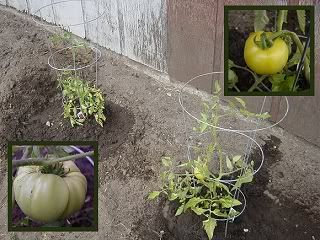
I told myself I wouldn't be growing any more tomatoes this year. I even gave homegrown seedlings away back in April. But the lure of free plants was just too strong, so a Beefsteak and Early Girl ended up taking up residence in a patch of dust in the backyard this evening. We'll see what a little compost and more root space can do for these undernourished underdogs... probably not much, but at least they have a fighting chance.

Elsewhere on the tomato front, the San Marzanos have hit five feet:


Last year's plants overwhelmed their tiny girly wire cages and flopped over mid-July, so this year, I adopted a more disciplined approach to staking. The Florida Weave system is all the rage on the tomato forums, and so far, it's working really well with very little time invested in maintenance. Every few days, I tuck a few branches into the pre-tied twine... and that's it! The vines are well-supported, and the tomatoes are easy to find and reach.

What's most important: it beats trying to wrestle a six-foot tomato vine off the ground every day, hands down!

Thursday, July 20, 2006

"Easy to grow"


Every packet of green bean seeds I've seen has been labeled "easy to grow," but let me tell you... I fought darn hard for the scant number of plants that are out there. I've never planted beans before, so maybe it was my experience level that was to blame. Maybe I planted too early. Maybe I should have planted on the sunny side or the berm. Maybe they just didn't get enough water. But... long story short, I had to replant these beans FIVE TIMES, and I still have a bald spot in the row.

On the bright side, the plants look productive-- I can hardly believe such a tiny little plant is capable of bearing so many pods! The variety I planted was 'Delinel,' a French bush bean. It has delicate little pink flowers and only grows 24 inches high. Every day, I pass a neighbor's garden, where he is growing seven-foot high pole beans covered with large yellow-and-white flowers. It's hard to believe that both plants are working toward a similar end product.

In other news, over at Flickr, you can see photos of the latest dahlia to bloom in the flowerbed and a couple of my cutest co-workers.